
What Parents Are Really Saying When They Say Their Kids Can't Learn Because of Neurodivergent Kids Being in the Classroom

I’ve been scrolling through social media lately and I keep seeing a narrative that stops me cold every single time.
Parents — parents of neurotypical children — sharing, posting, commenting that teachers cannot handle neurodivergent kids in their classrooms. That children with IEPs, autism, and special needs are disrupting their child’s learning. That “violent SPED students” are inflicted upon “regular classrooms.” That these kids are taking up too much of the teacher’s time. That they don’t belong there.
Before I got a reply that argues “no one is saying this,” here’s a few screen shots:


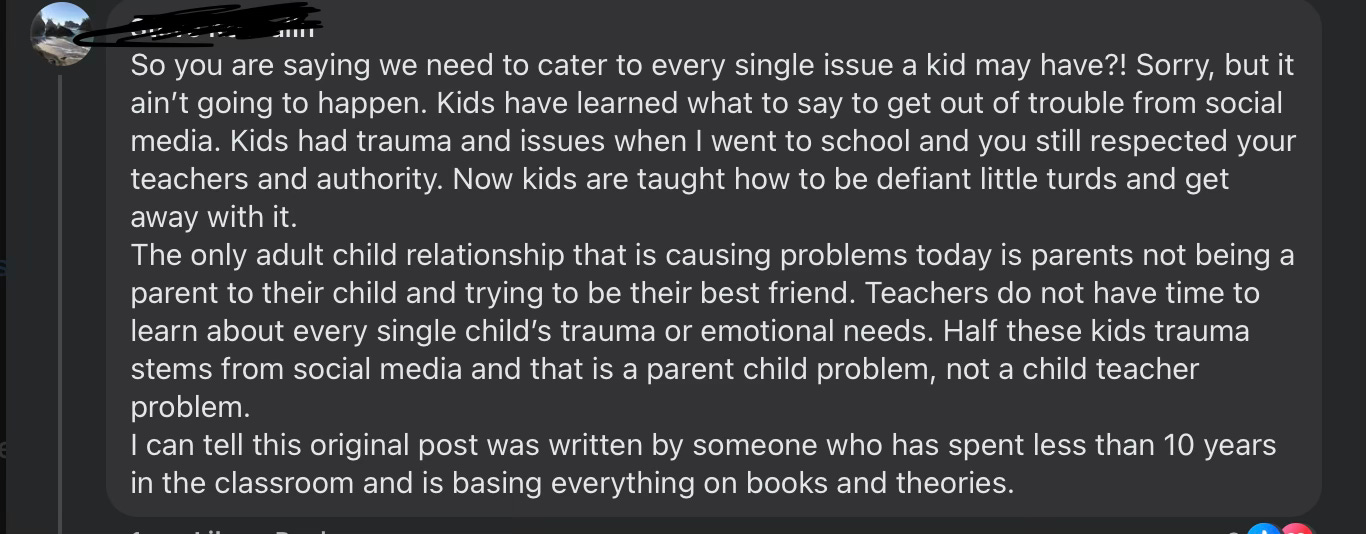
I want to be precise about what this is. This is not a frustrated teacher asking for more resources. This is not a parent of a neurodivergent child venting about a broken system. This is a parent, whose child faces no disability-related barriers to education, suggesting that another person’s disabled child should have less access to that same education.
Or that “teachers do not have the time to learn about children’s emotional needs.”
I’d argue that teachers especially need to learn about these needs, because our children are with them for 7-8 hours per day. Some people forget that education is not simply academics. It’s also social emotional learning, coping, emotions management, and peer relationship building as well as adult-child relationship building.
We need to talk about what it actually means when parents say these things.
This is not a logistical complaint. It’s a values statement.
When a parent says a neurodivergent child is disrupting their child’s learning, they are making a specific claim: that the educational experience of a neurotypical child is more important than the legal right of a disabled child to be in that classroom at all.
Let that land for a moment.
Not that the system needs more funding. Not that teachers need more support. Not that class sizes are too large. But that the neurodivergent child — that specific child, with their specific nervous system, their specific way of moving through the world — is the problem.
This is discrimination. And it is being normalized in comment sections and Facebook groups every single day.
The law exists for exactly this reason
In the United States, every child — every child — is legally entitled to a free and appropriate public education. The Individuals with Disabilities Education Act (IDEA) guarantees children with disabilities the right to individualized support in the least restrictive environment possible. The Americans with Disabilities Act (ADA) prohibits discrimination on the basis of disability in public institutions, including schools. Section 504 of the Rehabilitation Act ensures equal access regardless of disability.
Children with documented disabilities are legally given the right to be educated in the same classroom as their non-disability peers.
These laws did not appear out of nowhere. They were fought for, hard, by disability advocates and families who watched their children be turned away, separated, institutionalized, and excluded from the very spaces their neurotypical peers moved through without question. Parents who were horrified when their children were sent to basements in schools to be “handled” as “behaviorial problems” instead of being given access to the education all children by law are entitled to receive.
The narrative that neurodivergent children disrupt classrooms and should therefore be removed is not a new opinion. It is the old default — the one these laws were specifically written to dismantle.
When parents of neurotypical children repeat this narrative online, they are not just venting. They are actively pushing back against a legal and civil rights framework that exists to protect some of the most vulnerable children in our society.
These statements are harmful and discriminatory.
Let’s talk about what’s actually disrupting education
Underfunded schools. Undertrained staff. Chronically overcrowded classrooms. A curriculum that was designed by, and for, a narrow neurotypical standard — and has never been meaningfully updated to reflect the full range of human neurology.
These are the things disrupting education.
Not your neighbor’s kid with an IEP.
When we allow the conversation to center on the neurodivergent child as the source of disruption, we do the system’s work for it. We let underfunded institutions off the hook entirely. We redirect justifiable frustration about broken schools away from the policymakers, administrators, and funding structures that deserve scrutiny, and point it instead at a child who is simply trying to learn.
A child who, by the way, is already navigating a system that was not built with them in mind. A child who is already working harder than most of their peers just to exist in that classroom. A child who has now become the subject of adult grievances posted publicly on the internet.
What this does to our kids
Imagine being ten years old and the parents of your classmates are on Facebook arguing that you shouldn’t be there.
Imagine absorbing, from every corner of your environment, the message that your presence is a problem. That you are too much. That the other kids would be better off without you in the room.
This is not hypothetical. This is the daily reality of neurodivergent children in schools across this country.
The research is clear: children who feel unwelcome disengage. Their anxiety escalates. Their nervous system dysregulation — the very thing that gets pointed to as disruptive — worsens under conditions of chronic stress and social exclusion. We are not protecting neurotypical children by scapegoating their neurodivergent classmates. We are deepening the harm to everyone.
When neurodivergent learners are sent to exclusionary classrooms, or offsite schools where they do not have proximity to their non-disabled peers, this sends a very clear message: You do not belong in the general education setting.
What I want to say directly
If you are a parent of a neurotypical child and you have shared, liked, or nodded along to posts suggesting that neurodivergent kids don’t belong in mainstream classrooms, then I am asking you, genuinely, to pause and reconsider your stance.
Your child’s right to a good education is real and it matters. And it is not in competition with the rights of a disabled child to be in that same room.
The system failing your child and the system failing neurodivergent children is the same system. The underfunded classroom, the overwhelmed teacher, the lack of specialist supports, These are shared problems with shared causes. And the solution is never to decide which children deserve less.
Summer camps cannot discriminate against children with disabilities enrolling in their programs - so why does this subset of parents believe it’s ok for schools to discriminate against children with documented disabilities?
Our neurodivergent kids have a legal right to be in those classrooms and this summer camps. They have a human right to be seen as belonging there. And they deserve to grow up in a world where the adults around them are fighting for better systems, not for their exclusion.
They are not the problem.
They never were.

That is shocking that people are writing things like that about neurodivergent children in school. And no mention of this really issues around supporting so many children. There needs to be so much more understanding and advocacy.